
Two Steps Forward, One Step Back
Hopefully, you are blissfully unaware of what’s happening with the world stock markets. Not following them too closely is the correct approach for most investors. However, if you have not already, it’s likely that you will start seeing headlines bringing your attention to things other people want you to be worried about.
A few different themes are currently unresolved - the cost-of-living crisis, the Ukraine invasion, supply chain worries, recession fears and rising interest rates.
While these are real challenges that need to be overcome, we do not believe they warrant a change in any investor’s long-term strategy. Indeed, the real risk is that you do more harm than good by reacting to the situation. Mainstream media is hell-bent on scaring people - bad news sells.
We’ve Seen This Before
This year’s market decline (17%, at the time of writing) has now passed the annual average of about 14%, with fears that it will extend to 20% - the technical definition of a “bear market”.
Despite significant market gains since the outbreak of Covid, recent months have seen a decline in the stock prices of many industries, notably the tech darlings.
It’s normal to see a ‘reversion to mean’ across market sectors – sectors that rise sharply inevitably come down at some point. For this reason, diversification between countries and sectors is a foundational principle baked into your investment portfolios.
As with encountering an actual bear in the wild, the recommended course of action is to stand your ground and remain calm. Easier said than done, hey?
It’s worth remembering that it’s impossible to be a successful long-term investor without running into your fair share of bear markets. Understanding this may help you to approach the current one with confidence.
The visual below shows the post-WW2 bear markets (with a few 19% declines thrown in). While the frequency, magnitude, and length of the declines cannot be predicted (by anyone!), it’s worth noting that the index level has marched on stoically despite regular and significant bear markets.
We shouldn’t fear running into the next 20% decline; we should fear missing out on the next 100% advance.
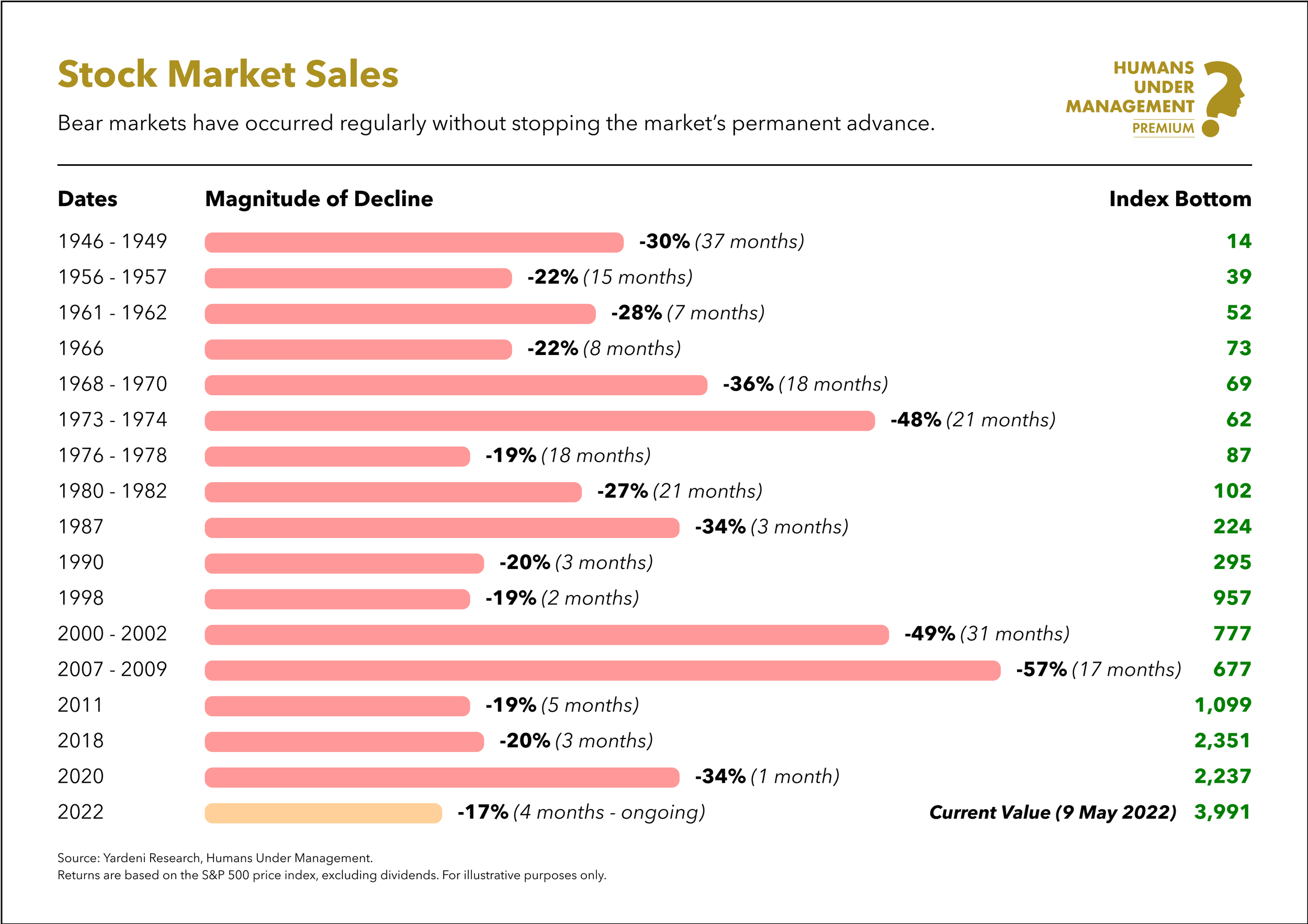
We propose that it is perfectly rational to expect future declines, and whilst we do not know when or why the current fears and market decline will end, we know that it will. We also know that trying to time the date and level of the current decline’s bottom is a fool’s errand. We think there’s a better way.
Remember The Game You Are Playing
For those playing short-term games (speculators and traders), the declines have a serious impact. No one knows what the next 12 months have in store; they never do. Similarly, if you have certain expenses on the horizon, the stock market is not the right place to provide for these.
But for those playing a long-term game of providing for, or protecting, an independent retirement, it is time again for discipline and patience. Successful investors dance with ambiguity, knowing that this uncertainty is ultimately the price of entry for earning superior long-term returns.
Counter-intuitively, during times of falling prices, the expected future value of the stock market increases. For those still accumulating (most people), these periods are when future fortunes are made. You are buying stock market units at fire-sale prices; it’s a financial gift.
The coming months will test your resolve. Many investors will succumb to the temptation to bail, but in our view, this makes no more sense than jumping off a roller-coaster mid-ride, an unwise move.
When the cycle does turn, which it will, you’ll be one step closer to being the mature investor your family deserves. As JP Morgan famously said, “In bear markets, stocks return to their rightful owners.”
Please remember that we understand the difficulty in doing nothing when you feel you should act. Standing firm is difficult, but history (our only guide) has shown that it’s the only sure way of navigating these uncertain times. We are here if you have any questions.